

You spent months climbing to page one. Optimized every meta tag. Built the backlinks. Hit position three for your most important keyword. And now your potential customers are asking ChatGPT the same question your content was built to answer - and your brand isn't mentioned once.
Welcome to the most uncomfortable truth in digital marketing right now: Google rankings no longer guarantee AI visibility. And for brands that don't adapt, that gap is only going to widen.
The Number That Should Alarm Every Marketer
Not long ago, the connection between Google dominance and AI citations felt intuitive. If you ranked in the top 10 on Google, surely the AI models pulling from the web would find you too.
That assumption is now broken.

The top 10 Google results once accounted for 76% of ChatGPT citations. That number has since collapsed to just 38%. More striking still: 90% of pages cited by AI models now rank 21st or lower on Google.
Read that again. Nine out of ten pages that AI is citing and surfacing to users don't even appear on page one of traditional search results.
This is not a minor calibration. This is a structural shift in how information gets discovered, evaluated, and delivered to the people who are making purchasing decisions right now. The brands that understand this early will own the next decade of digital visibility. The ones that don't will keep pouring resources into an SEO playbook that's becoming less relevant by the quarter.
From Ranking to Retrieval: A Completely Different Game
The old objective was simple: rank higher than your competitors for high-intent keywords, and traffic follows. The new objective is fundamentally different: become the most trustworthy, relevant, and easily extractable source for AI models operating across the entire web.
That distinction - ranking versus retrieval - is the frame that should reshape your entire content and distribution strategy.
AI models don't browse search results pages. They perform dynamic retrieval across vast training data and live web crawls, pulling information from wherever it lives: your website, yes, but also Reddit threads discussing your category, YouTube videos where experts mention your brand, G2 and Trustpilot reviews your customers left, niche industry publications you've never pitched, podcasts where a founder was interviewed three years ago.
Your brand's AI visibility is the sum of your entire digital footprint - not just what you control.
Five Strategic Shifts to Own AI Search
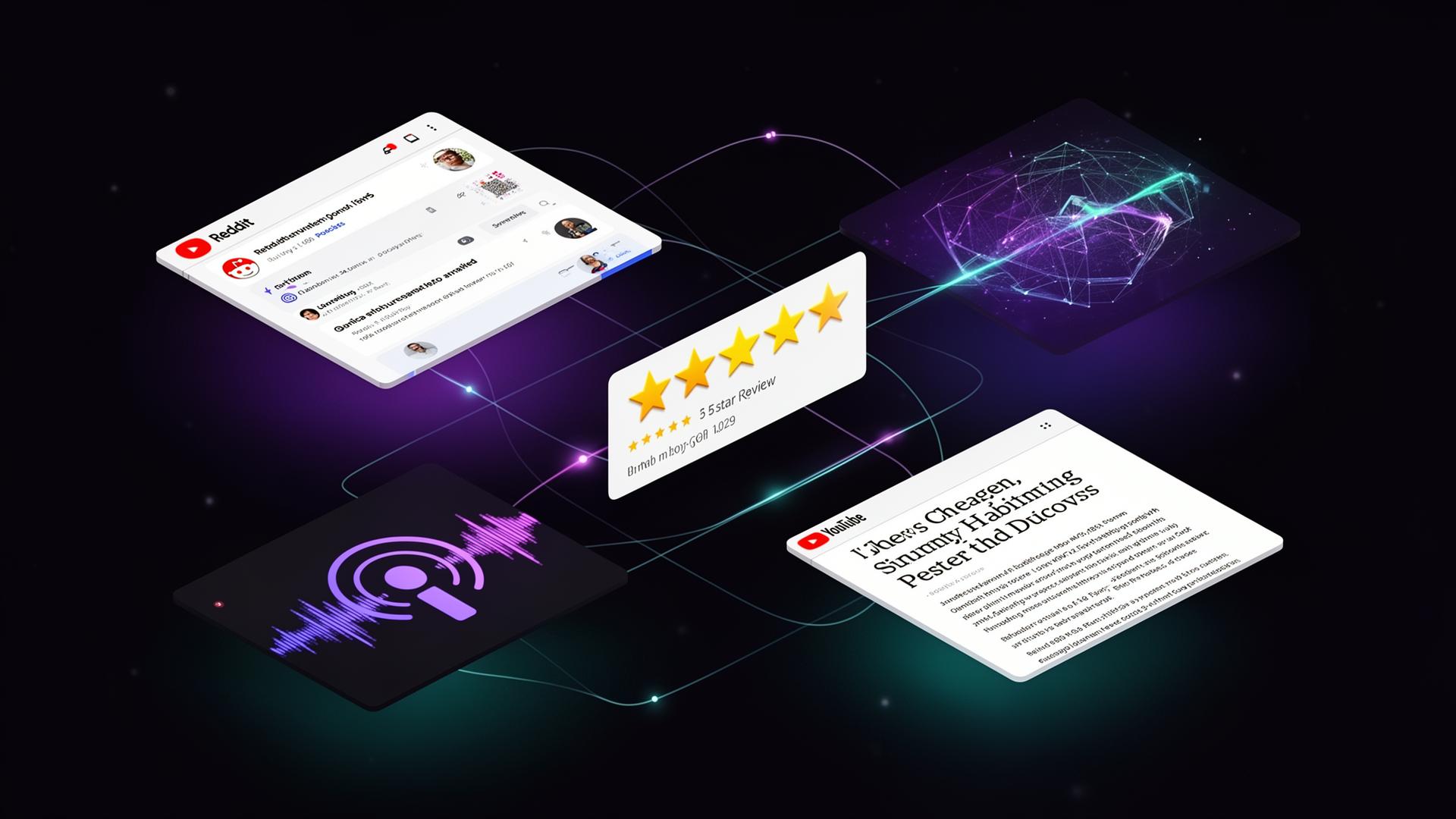
1. Build Presence Everywhere Your Audience Talks
Most brands treat content strategy as a website problem. Publish more blog posts. Improve on-site SEO. Update the homepage copy. But if your only presence is on your own domain, AI models have a thin, single-source picture of who you are - and thin evidence gets deprioritized.
AI retrieval is inherently democratic. It doesn't care that you own the website; it cares about the weight of corroboration across the web. A brand mentioned consistently across Reddit forums, industry newsletters, YouTube reviews, third-party comparison sites, and analyst reports is a brand the model can confidently associate with a topic.
The diagnostic exercise here is simple: search your brand name alongside your core topic and see what third-party sites surface. Those are the platforms where your presence either exists or doesn't. Build it where it's missing - through PR pitches to relevant publications, podcast appearances, expert contributions to community discussions, and proactive review generation on platforms like G2 or Capterra.
This isn't a one-time campaign. It's a distribution mindset that needs to become as habitual as publishing on your own site.
2. Structure Your Content for Extraction, Not Just Reading
Here's something that reveals how fundamentally AI consumption differs from human reading: GPT-5.4 is reportedly seven times more likely to cite brand websites than its predecessor GPT-5.3. The reason is architectural - it performs multiple sub-queries to locate specific data points rather than reading pages linearly.
But here's the critical caveat: it will skip your page entirely if the information it needs isn't easy to extract.
Dense paragraphs, long-form narrative prose with no structural signposting, pages that bury answers beneath introductions and caveats - these formats are poorly suited to AI retrieval, regardless of how well-written they are. AI models are looking for clear, isolated, authoritative statements they can lift and attribute.
The practical fix is less glamorous than it sounds: use clear H2 headings that function as standalone questions or topic labels. Add FAQ sections at the bottom of cornerstone pages. Break up complex arguments into discrete, labeled sections. Define terms explicitly. State conclusions directly, not just implicitly.
And don't overlook the technical side: check your robots.txt file. A surprising number of brands are accidentally blocking AI crawlers like GPTBot through overly aggressive exclusion rules that were set up years ago for different reasons. If your content isn't crawlable by the model, none of the above matters.
3. Stop Treating AI Search as a Single Channel
"AI search" is not one thing. ChatGPT, Gemini, Claude, and Meta AI are distinct platforms with different retrieval architectures, training data compositions, source preferences, and - crucially - different user bases.
This matters enormously for B2B brands in particular. Developers and technical buyers skew heavily toward Claude for its precision and extended reasoning. Finance and enterprise teams frequently default to Gemini because of its integration with Google Workspace. Creators and general consumers lean toward ChatGPT. Meta AI is capturing enormous volume in social-native contexts.
If your buyer persona is a developer-led SaaS team evaluating your product, your visibility on Claude is more commercially valuable than your visibility on Meta AI, even if Meta AI serves a larger raw audience.
The diagnostic step is to actually test each platform. Run your core buying questions through ChatGPT, Gemini, Claude, and Meta AI separately. Note which competitors are cited, which sources are referenced, and whether your brand appears at all. Then build a platform-weighted strategy that prioritizes the tools your actual buyers are using.
This level of segmentation isn't premature sophistication - it's the basic due diligence that serious brands will be doing within the next 18 months.
4. Build Entity Association, Not Just Backlink Profiles
Traditional SEO gave brands a clear objective metric: acquire more backlinks from higher-authority domains. While backlinks still carry weight in Google's algorithm, they are only loosely correlated with what AI models actually use to evaluate credibility.
AI prioritizes what might be called "entity association" - the confidence with which a model can connect your brand to a specific topic based on evidence across the full breadth of the web. This is different from link-counting. A hundred links from mediocre blogs that don't contextually discuss your category do less for AI visibility than a single detailed mention in a respected industry report, a Wikipedia entry that establishes your brand's position in a category, or a third-party analyst piece that cites you as a reference in a relevant vertical.
The strategic implication is a reallocation of effort from self-promotional publishing to third-party validation. That means pursuing Wikipedia entries and edits where appropriate, contributing to industry survey data that gets cited in research reports, actively earning placement in the publications your category's analysts read, and making it easy for your customers to leave detailed, public reviews that mention specific use cases.
Your own blog is necessary but not sufficient. The web's commentary about you matters more to AI than what you say about yourself.
5. Treat Content Freshness as a Ranking Signal - Because It Is
There's a freshness bias built into how AI models retrieve and prioritize sources, and the numbers are striking: for ChatGPT, the average age of a cited source is approximately 80 days.
That is not a lot of runway for content that hasn't been touched in two years.
AI models are tuned to prefer recent data because recency is a reasonable proxy for accuracy in fast-moving domains. Updated statistics, current examples, and fresh data signal that a source is actively maintained and therefore more likely to reflect the current state of a topic. Stale pages - even authoritative ones - get deprioritized when a more recently updated alternative exists.
The practical response isn't to create more content. It's to systematically refresh the content that already matters. Identify your top ten highest-value pages - the ones that rank for important terms, drive meaningful traffic, or address core buying questions - and build a quarterly refresh cycle into your editorial calendar. Update the statistics. Replace outdated examples. Add a section addressing developments in the last six months. Change the publication date only when the refresh is substantive.
This approach leverages the authority you've already built rather than starting from zero, and it sends a consistent signal to both AI models and traditional search engines that your content is actively maintained.
What This Means for Your Brand Right Now
The companies that will lead in AI-powered discovery aren't necessarily the ones with the biggest content budgets or the most sophisticated SEO infrastructure. They're the ones that move first on a genuinely different model of digital presence.
That model requires thinking beyond your domain. It requires structuring content for extraction rather than just engagement. It demands platform-specific intelligence about where your buyers are actually asking their questions. It prioritizes third-party validation over self-promotion. And it treats content maintenance as a continuous operational discipline, not a one-time publishing event.
The transition from search engine optimization to AI engine optimization is not a future consideration. The brands getting cited in ChatGPT and Gemini today are already capturing mindshare that influences purchase decisions - and that advantage compounds the longer it persists.
The question isn't whether AI search matters to your category. The question is whether your brand is visible when the conversation happens.
If you ran the test right now - typed your most important customer question into ChatGPT - would your brand appear?
If the answer is no, or you're not sure, that's the most important metric in your marketing stack. And it's one that a Google ranking report won't tell you anything about.